
Cabaçal VMS belt
Brazil's premier underdeveloped
VMS belt
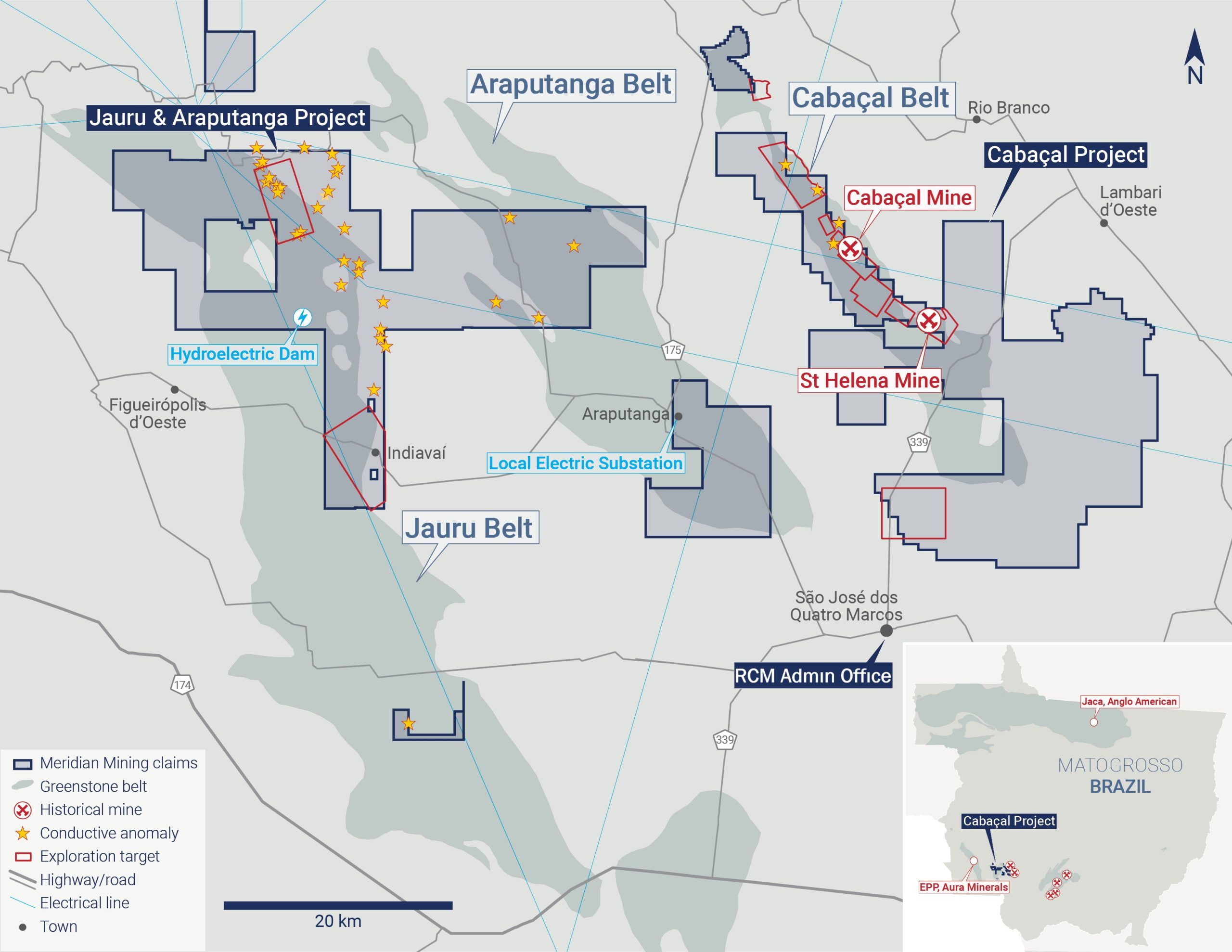
Click image to enlarge
Cabaçal is a district scale VMS project endowed with near surface Copper-Gold-Silver-Zinc mineralisation with optimal geometry for open-pit development.
Located on grazing farmland in the State of Mato Grosso, with good community support backed by past operational history. Cabaçal benefits from existing local infrastructure including Road access, Rail ~385 km, and Power Substation ~20 km. The region is a net exporter of sustainable Hydroelectricity, with several locations within 50 km of the project. The regional capital of Cuiabá is 4.5 hours by car to the west while the state has an active, well serviced and producing mining sector.
Advanced permitting covering 1,070 km2 :
- Cabaçal – Mining Lease Application
- St Helena – Mining Licence
- Cabaçal Extensions – 8 x Exploration Licences
- Jauru & Araputanga belts – 12 x Exploration Licences
This district-scale asset hosts shallow polymetallic mineralisation suited to surface mining, supporting efficient extraction and growth potential.
Situated in a supportive mining region, the project benefits from strong local backing and access to transport links, power, and renewable energy.
History of the
Cabaçal VMS Belt
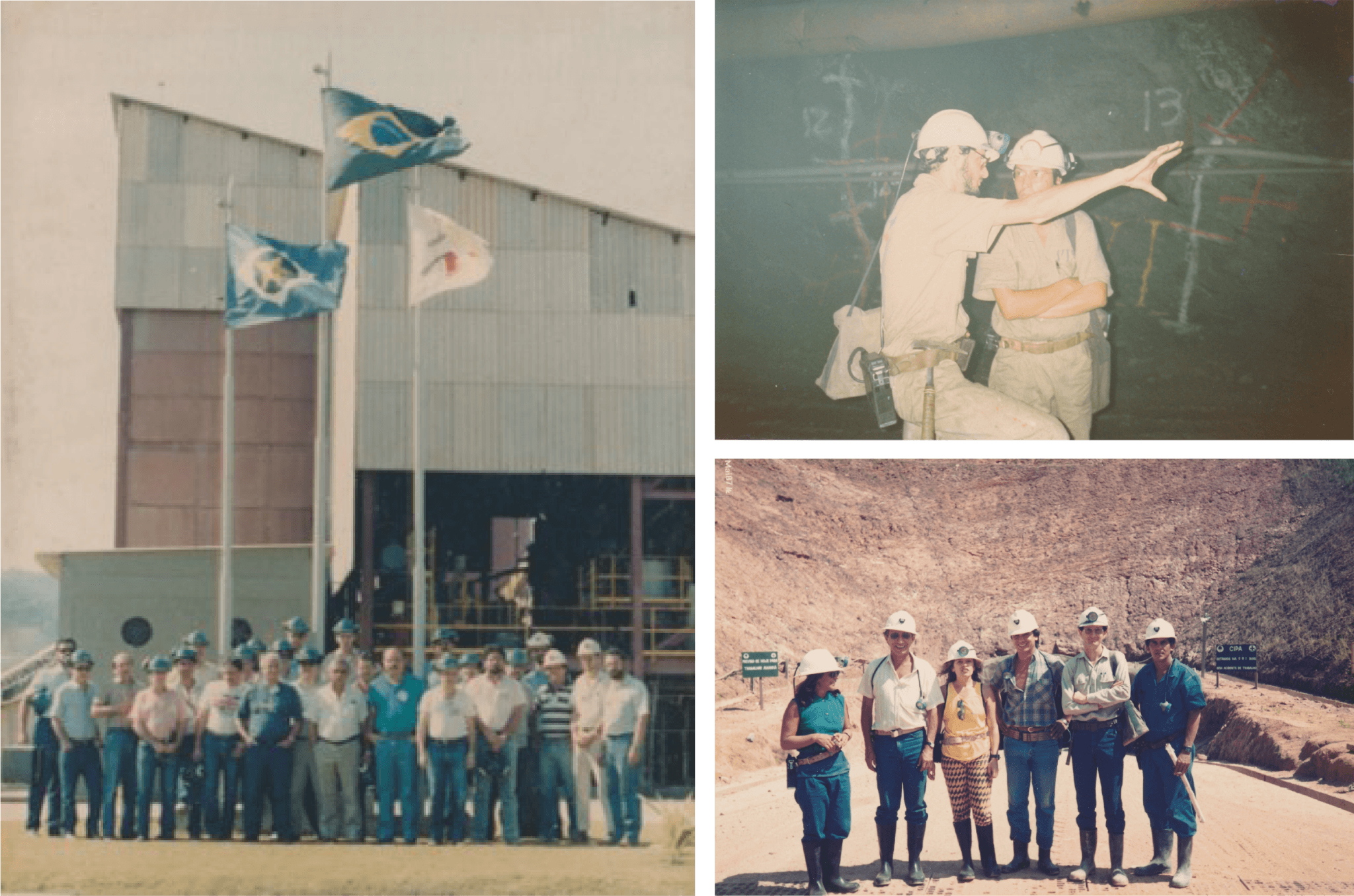
Cabaçal was only discovered by BP Minerals in 1983, and formed part of their global portfolio. Then operated as a small-scale underground gold mine from 1987 to 1991 mining ore at a high-grade + 3g/t Gold cut-off grade. This focus on high-grade Gold, left behind known layers of extensive, open, shallow Copper-Gold-Silver mineralisation for Meridian to expand and develop.
The mine was acquired by RTZ (Rio Tinto), as part of the purchase of BP Minerals in 1989, it was decommissioned in 1991. Cabaçal was held via a single Brazilian private company, until 2020 when Meridian signed the option agreement. Meridian has recovered an extensive part of the Cabaçal database that it is using to guide its development. In 2021 Meridian commenced an extensive field programme leveraging off this data, that has been hugely successful in confirming and expanding Cabaçal’s Copper-Gold-Silver mineralisation.
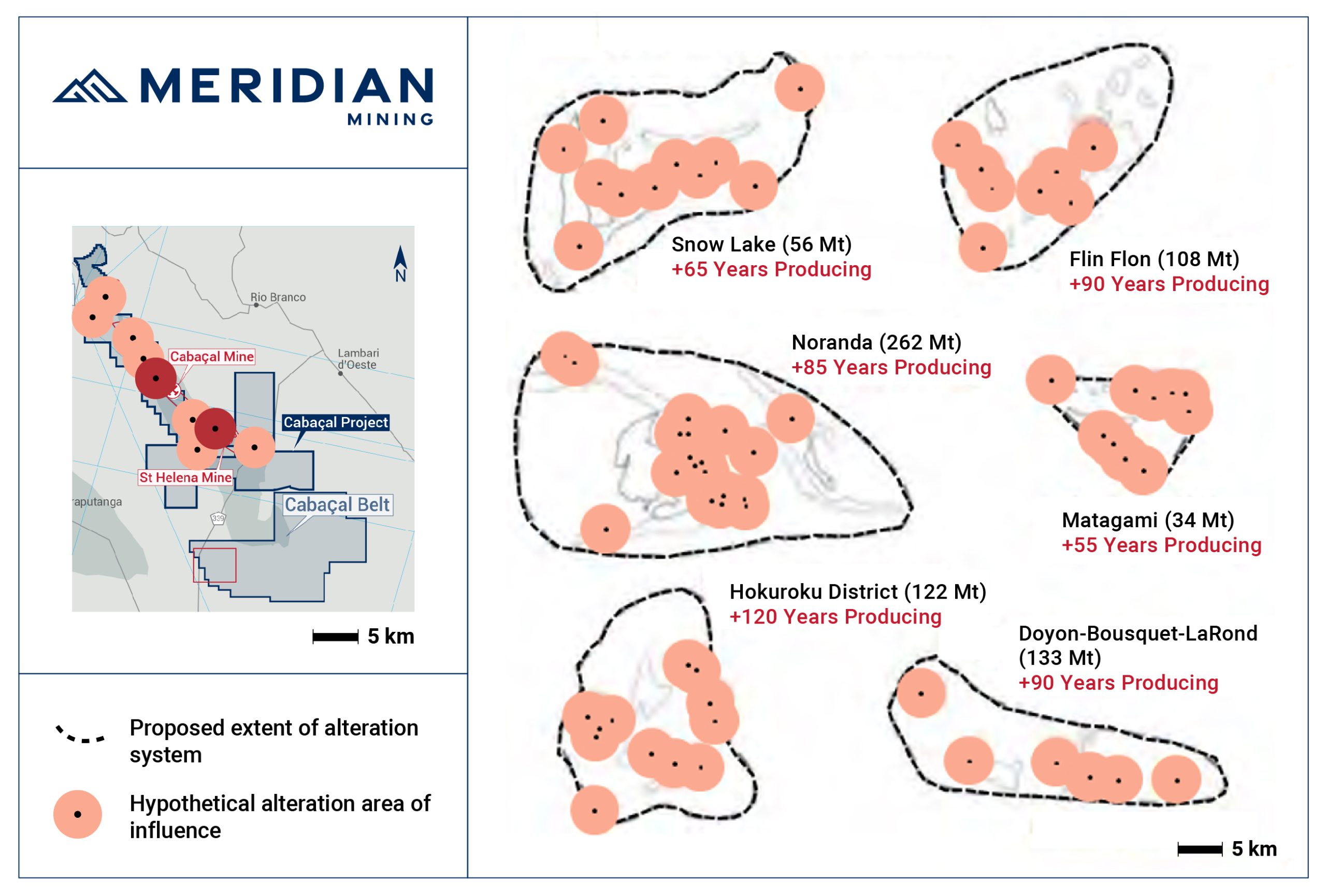
Click image to enlarge
Geology
The Cabaçal and St Helena deposits and other known targets form part of a Paleoproterozoic VMS system in deformed metavolcanic-sedimentary rocks of the Alto Jauru Greenstone belt.
The package consists of a bimodal sequence, similar to many major VMS districts. Cabaçal’s stacked mineralisation lenses with cumulative thicknesses up to 90 meters and are variably enriched in Cu-Au-Ag & Zn-Pb.
VMS camps like, Cabaçal, typically host a cluster of deposits, not uncommonly spaced at 4 to 6 km intervals, making both near-mine and regional exploration targets attractive. The production history of the world’s VMS camps has been defined over decades, sometimes +100 years, with their near surface resources largely exhausted. Cabaçal presents the opportunity for Meridian to create value from this undeveloped VMS camp.